
Standing up a real SaaS backend — config, admin, payments, realtime, docs — takes weeks of boilerplate, and the result is opaque to the AI coding agents teams now build with.
The framework should disappear, and it should be legible to machines. Wire the proven pieces together once behind a type-safe configuration layer, and expose the whole capability graph through MCP so coding agents query what it can do instead of scraping prose docs.
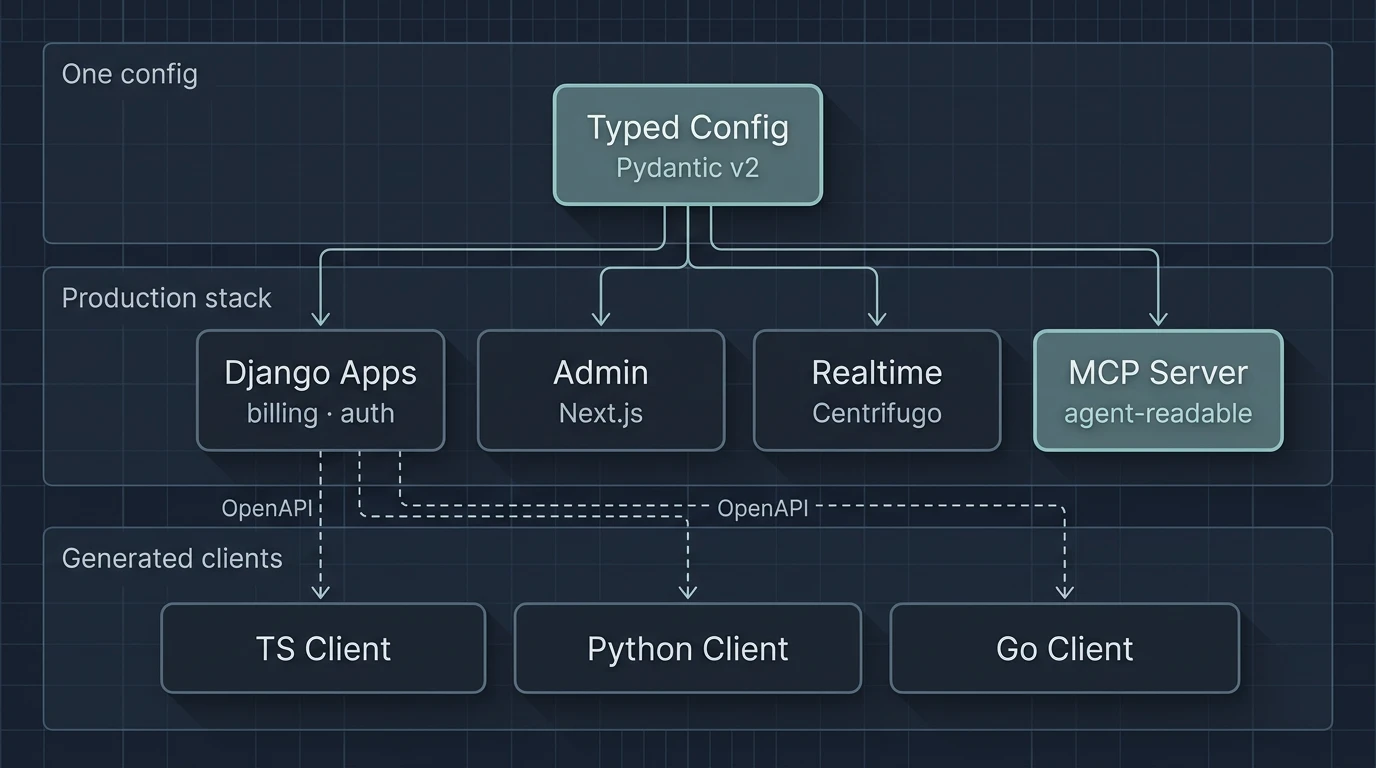
DjangoCFG is an opinionated, AI-native framework that replaces Django's settings model with a type-safe Pydantic v2 system and unifies Django, a Next.js admin, payments, and realtime (Centrifugo) into one coherent architecture. Capabilities are exposed through an MCP server, so agents read schemas directly.
A single configuration object drives the stack: models validated through Pydantic v2, MCP endpoints generated from type definitions, a Next.js frontend scaffolded to match, and a realtime layer wired into the Django event bus. Convention over configuration — but the conventions are right.
Framework decisions are architectural decisions made once for every team that uses them. DjangoCFG is opinionated because indecision at the infrastructure layer creates permanent technical debt for every product built on top of it.
Making MCP a first-class citizen of a Django application required rethinking how Django exposes its internal model graph. The result is a type-safe bridge between Django ORM definitions and MCP tool specifications — generated, not handwritten.
- First-deploy setup
- Weeks→30s First-deploy setup
- Native AI interface
- MCP Native AI interface
- Open source
- OSS Open source
Native support for agent-facing APIs, streaming responses, and a plugin model that lets teams extend the configuration layer without forking the framework.